

By CleopatraRX | Medically Reviewed by Manasa Murthy, PharmD | Updated March 2026
Key Takeaways
- The 2026 estradiol patch shortage affects all major brands, including Climara, Vivelle-Dot, and generics from Teva and Mylan.
- Several FDA-approved alternatives exist: oral estradiol tablets, gels, and sprays. Your prescriber can guide a safe switch.
- Use this time to reevaluate your goals of therapy. If cognition is a priority, consider oral estriol — a distinct estrogen with a different receptor binding profile that preferentially targets ERβ, which is enriched in the brain rather than breast and reproductive tissue. It has been used safely in Europe for more than 40 years.
- Hippocampus and prefrontal cortex are the brain regions responsible for verbal memory, processing speed, and executive function. These are the same regions that show measurable atrophy on MRI in menopausal women with untreated cognitive symptoms relative to pre-menopausal women.
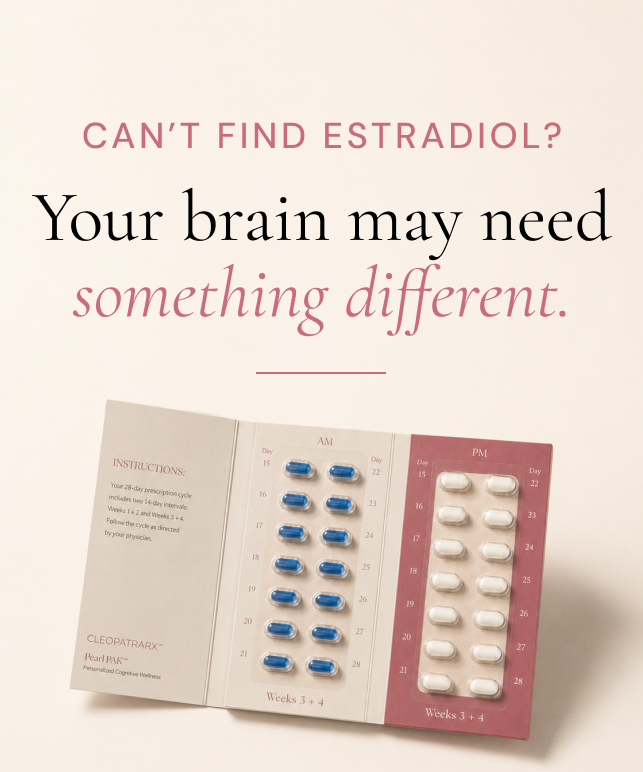
- PearlPAK® by CleopatraRX is a compounded oral estriol and progesterone protocol developed from UCLA and NIH research. It is designed for women whose primary concern is cognitive health during perimenopause or menopause.
What Is Happening With the Estradiol Patch Supply?
If you’ve gone to refill your estradiol patch recently, you’ve likely been told it is unavailable. For many women, this is more than an inconvenience. It raises immediate questions about symptom control, safety, and what to do next. Across the US, pharmacies are reporting the same message: estradiol patches are on indefinite backorder. The shortage, which intensified throughout 2025, affects all major brands including Climara, Vivelle-Dot, and generics from Teva and Mylan, with no clear resolution timeline from manufacturers. It is expected to continue through the end of 2026.
The crisis stems from supply chain disruptions at multiple production facilities, compounded by record demand for menopausal hormone therapy (MHT). The FDA’s November 2025 removal of the black box warning on MHT products contributed to a significant increase in prescriptions at a time when manufacturing capacity was already strained.
The immediate priority is making sure you do not lose symptom control or stop treatment abruptly without guidance. For many women, switching to another estradiol format will solve the short-term problem. For others, this shortage may also be the moment they start asking a bigger question: Is my current hormone therapy actually addressing my most important symptoms?
How to Navigate the Shortage: Practical Steps
Step 1: Use This Moment to Reassess Your Goals
The shortage is disruptive, but it may also be a useful moment to revisit whether your current therapy is fully addressing your symptoms, especially if cognitive changes remain a concern. If brain fog, word-finding difficulty, or processing speed changes are concerns, discuss them now with your provider. The sections below are directly relevant to that conversation.
Step 2: If Estradiol Meets Your Current Goals, Here Are Your Options
Several estradiol formulations remain available and are clinically interchangeable for most indications. The patch is one delivery format for the same medication.
- Oral estradiol tablets (e.g., Estrace) are the same active hormone and are an option for many women. Note that oral estradiol is metabolized through the liver and may carry a modestly higher clotting risk for women with cardiovascular risk factors.[1]
- Estradiol gel (e.g., EstroGel, Divigel) is transdermal with a similar absorption profile to patches and is widely available.
- Estradiol spray (Evamist) is also transdermal. Comparative data are more limited but it is effective for symptom control.
- Vaginal estradiol has low systemic absorption and addresses genitourinary symptoms only, not hot flashes or cognitive symptoms.
Switching formulations may require a brief adjustment period. Plan a follow-up with your provider four to eight weeks after any change.
Step 3: If Cognitive Symptoms Remain a Priority, It May Be Worth Discussing Oral Estriol
For many women, switching to another estradiol formulation will be enough. But if brain fog, word-finding difficulty, or slowed processing have remained concerns even while using estradiol, this may be a reasonable time to ask whether a different estrogen approach better fits your goals. Estradiol is effective for hot flashes, sleep, and genitourinary symptoms. However, it has not been shown to be specifically neuroprotective for the cognitive domains most affected in menopause, including verbal memory, processing speed, and working memory.[2] If you experienced brain fog, word-finding difficulty, or processing challenges while on the patch, oral estriol may be worth a conversation with your provider. To learn more about the differences between estriol and estradiol, read our detailed guide on the difference between estriol and estradiol.
Step 4: Talk to Your Doctor About Your Options
Do not wait for the pharmacy to resolve the shortage. Contact your prescriber today. They can review your current dose and treatment goals and recommend the safest alternative for your situation. A same-week phone or telehealth visit is appropriate.
If you are interested in oral estriol, learn more here.
To understand why some women and clinicians consider estriol when cognition is the primary concern, it helps to understand how different estrogens interact with different estrogen receptors in the body.
Understanding the Difference: ERα vs. ERβ
Not all estrogens behave the same way in the body. Understanding the difference between estradiol and oral estriol starts with two receptor types.
- Estrogen receptor alpha (ERα) is abundant in reproductive tissues and breast. Estradiol binds strongly here. ERα activation drives the proliferative breast tissue effects that were associated with increased cancer risk in the Women’s Health Initiative studies.[3]
- Estrogen receptor beta (ERβ) is enriched in the hippocampus and prefrontal cortex, the brain regions responsible for verbal memory, processing speed, and executive function. These are the same regions that show measurable atrophy on MRI in menopausal women with untreated cognitive symptoms.[4]
Estradiol is effective for hot flashes, sleep, and bone density. An estrogen that preferentially binds ERβ may provide more targeted brain support for women whose primary concern is cognitive function.
One important distinction: the safety findings from the Women’s Health Initiative applied to estradiol and progestin. Oral estriol has a different receptor profile and a separate body of safety evidence. Risks should not be assumed to be identical across estrogen types.
A Brain-First Estriol Option for Women with Cognitive Symptoms
PearlPAK® is a compounded estriol and progesterone protocol developed from Dr. Rhonda Voskuhl’s NIH-funded research at UCLA. It is designed for women in perimenopause or menopause whose primary concern is cognitive health, while also supporting common symptoms such as sleep disruption, mood changes, and hot flashes.
Who PearlPAK® Is Designed For
Consider discussing PearlPAK® with your provider if you:
- Experience brain fog, word-finding difficulty, or slowed processing as your primary symptom
- Have a family history of cognitive decline and are interested in a neuroprotective approach
- Are concerned about long-term estradiol use and want to understand a formulation with a different receptor and safety profile
Who Should Not Use PearlPAK®
PearlPAK® is not indicated for women with a personal history of estrogen-sensitive breast cancer, history of blood clots or thromboembolism, untreated endometrial hyperplasia, or known hypersensitivity to estriol or progesterone.
The Science Behind Oral Estriol
The clinical foundation for PearlPAK® comes from Dr. Voskuhl’s published research in multiple sclerosis. Women with MS consistently experience fewer relapses during pregnancy, when estriol levels peak naturally, and worsen after delivery when estriol disappears.[5] This pattern led to clinical trials testing estriol’s neuroprotective effects directly.
- In the Phase 2b MS trial published in Lancet Neurology (2016), women treated with estriol 8mg per day showed improved cognitive processing speed, reduced cerebral cortex atrophy on MRI, and reduced blood biomarkers of neurodegeneration compared to placebo.[6]
- In parallel preclinical research, ERβ stimulation in brain astrocytes improved cognition, prevented hippocampal atrophy, and reduced neuropathology in a menopausal mouse model.[7]
One important caveat: large-scale randomized controlled trial data for oral estriol in menopause specifically is still emerging. The strongest published evidence comes from the MS trials and preclinical models. Dr. Voskuhl’s ongoing NIH-funded research is working to close this gap.
Safety Profile of Oral Estriol
Oral estriol has been prescribed in Europe for more than 40 years, primarily for genitourinary and menopausal cognitive symptoms. Long-term safety reviews have found no increased risk of breast cancer at therapeutic doses.[8]
Unlike oral estradiol, oral estriol does not appear to carry the same elevation in venous thromboembolism risk, though large prospective trials specific to oral estriol remain limited.[9]
In Dr. Voskuhl’s MS trials, participants received 8mg per day, which is double the PearlPAK® menopause dose of 2 to 4mg per day, for two years with no significant safety signals. This supports confidence in the lower menopause dosing, though clinical monitoring is still required.[6]
How PearlPAK® Works
PearlPAK® is compounded by two national PCAB-accredited pharmacies[10] and shipped within the United States excluding Hawaii and Alaska under valid prescription. The blister pack format was designed specifically for women experiencing cognitive symptoms, because asking someone with memory difficulties to manage separate bottles and timing creates its own compliance burden.
Dosing is individualized based on symptom profile. CleopatraRX clinical staff track outcomes using the Voskuhl Menopause Brain Fog Assessment at baseline and 12-month intervals, providing an objective measure of treatment response over time.
Cost and Access
Because PearlPAK® is compounded, it is not covered by standard insurance formularies. Out-of-pocket cost can be found at the CleopatraRX home page.
Next Steps
Running into a shortage can feel disruptive, especially if your current hormone therapy has been working well enough to keep daily life manageable. But you do have options, and for some women this moment becomes an opportunity to choose a treatment approach that better matches their symptoms and long-term priorities.
If your estradiol patches are unavailable:
- Contact your prescriber today. Do not wait for the pharmacy to resolve the issue.
- Ask about estradiol gel, spray, or oral tablet alternatives at an equivalent dose.
- If cognitive symptoms are your primary concern, ask specifically whether oral estriol may be appropriate for you.
- Visit cleopatrarx.com to take the Voskuhl Menopause Brain Fog Assessment and connect with a clinical provider licensed in your state.
Your primary physician can also prescribe PearlPAK using the prescriber portal at cleopatrarx.com.
The shortage is disruptive, but it can also be a useful moment to revisit what you want your hormone therapy to do, not only for hot flashes and sleep, but for your brain and your long-term quality of life.
References
[1] Canonico M, et al. Hormone therapy and venous thromboembolism among postmenopausal women: impact of the route of estrogen administration. Circulation. 2007;115(7):840–845.
[2] Andy C, et al. Systematic review and meta-analysis of the effects of menopause hormone therapy on cognition. Front Endocrinol. 2024;15:1350318.
[3] Rossouw JE, et al. Risks and benefits of estrogen plus progestin in healthy postmenopausal women: principal results from the Women’s Health Initiative. JAMA. 2002;288(3):321–333.
[4] Mosconi L, et al. Perimenopause and emergence of an Alzheimer’s bioenergetic risk profile in brain and cognition. PLOS ONE. 2017;12(10):e0185926.
[5] Voskuhl RR, Wang H. Multiple sclerosis, pregnancy, and estriol. Curr Opin Neurol. 2002;15(3):293–297.
[6] Voskuhl RR, et al. Estriol combined with glatiramer acetate for women with relapsing-remitting multiple sclerosis: a randomised, placebo-controlled, phase 2 trial. Lancet Neurol. 2016;15(1):35–46.
[7] Itoh N, Itoh Y, Meyer CE, et al. Estrogen receptor beta in astrocytes modulates cognitive function in mid-age female mice. Nat Commun. 2023;14:6044. doi:10.1038/s41467-023-41723-7
[8] Head KA. Estriol: safety and efficacy. Altern Med Rev. 1998;3(2):101–113. Also: Lauritzen C. Results of a 5-year prospective study of estriol succinate treatment in climacteric patients. Maturitas. 1987;9(3):259–274.
[9] Canonico M, et al. 2007. (See [1]. Note: large prospective VTE trials specific to oral estriol remain limited; this citation addresses the route-of-administration distinction for estradiol.)
[10] Pharmaceutical Compounding Accreditation Board (PCAB). Standards for Sterile and Non-Sterile Compounding. pcab.pharmacy.